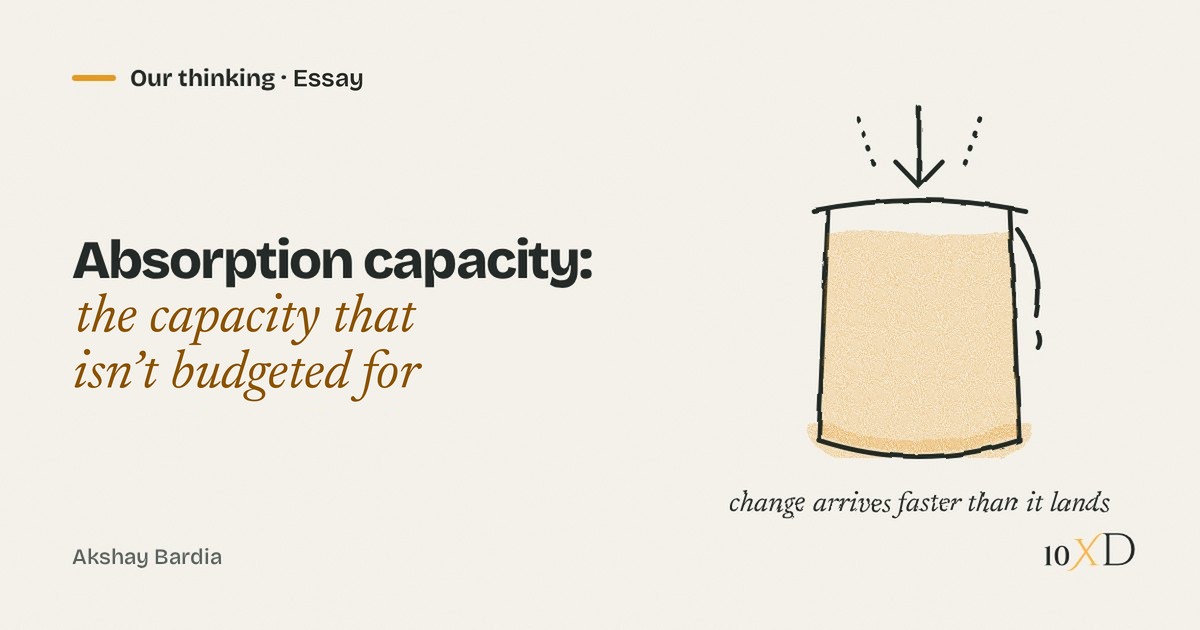
In my work with retailers I keep seeing the same thing happen. The clearest example I can remember was at Easter. The stores' whole focus was getting Easter products on shelf, and that was the season in which several new tools and processes were sent out to them at the same time. Something similar happens at head office when one team is asked to run three programs at once. People can only take on so much in a season, so when too much arrives together, the most important change gets the same thin attention as everything else, and it doesn't stick.
What follows is fairly predictable. The program shows no uplift, the stores stop giving feedback, and the two sides start to blame each other. Head office concludes that stores don't change. Stores conclude that head office doesn't understand the job on the ground and thinks a new tool will fix it. I think this is the worst part of the cycle, because these programs are usually meant to bring head office and stores closer together. Instead they leave the two further apart, which makes the next program harder to land.
Retailers budget money and technology for these programs. What they rarely budget is how much change a store team or a planning team can take on in a season, and in my experience that is the limit they run into first. I call it absorption capacity.
Part of the reason is the way retailers are set up. Customers deal with a retailer through its stores and its website. The business itself runs from sourcing, through the supply chain, into the back of the store and onto the floor. The CEO and the leadership team work from what is, in practice, a store support centre, and IT sits there with them. Because AI is technology at its core, it usually ends up treated as an IT matter, planned at head office and often owned by IT, and there are good reasons for that. The difficulty is that the strategy is put together at head office, while the change itself has to happen in hundreds of stores, among people whose days are already full.
BCG's rule of thumb is that AI value comes 10% from algorithms, 20% from technology and data, and 70% from people and processes (BCG). If that's roughly right, a strategy owned mainly by IT is focused on a small share of what decides whether it pays off.
What the research says
I wanted to know whether this was just my experience, so I looked for wider evidence. I found four studies that point in the same direction.
Exhibit 1. What the research says
| Theme | Finding | Source and caveat |
|---|---|---|
| Change load | The average employee went through 10 planned enterprise changes in 2022, up from 2 in 2016. Willingness to support change fell from 74% to 38%. | Gartner, as reported by the NeuroLeadership Institute. All industries, not retail-specific. |
| Tool friction | Only 5% of UK store staff reported no major friction with in-store technology. 41% had too many devices, 39% cited dashboard overload, 29% were overwhelmed by alerts. | x-hoppers (Wildix), reported by IT Brief, June 2026. Vendor research. |
| Perception gap | 80% of senior retail decision makers said smart technology was used to its full potential and 79% said training was sufficient. Fewer than half of store staff said it made their jobs easier; 41% said head office didn't consider their needs. | VoCoVo, Retail Disconnected, 2022. 1,000+ store colleagues and 250 decision makers, UK, Germany, US. Vendor research. |
| Frontline AI | 72% of employees used AI regularly, but frontline use had stalled at 51%. 25% of frontline workers said leaders gave enough guidance; 36% of employees felt adequately trained. | BCG, AI at Work 2025. 10,600+ workers, 11 countries. All industries. |
None of these studies is conclusive on its own, and two of them were done by vendors who have an interest in the answer. Taken together, though, they suggest that more change is landing on employees, that store staff already find their existing tools hard work, and that head office tends to think technology is going better in stores than store staff do.
What I mean by absorption capacity
By absorption capacity I mean the amount of change a team can take on in a given period while still running the business well, so that the change actually sticks. I find it more useful to think about it for a particular role in a particular season than for the company as a whole. A store team in December, for example, has far less room for something new than a planning team does in March. In my experience four things determine it.
Exhibit 2. The four drivers of absorption capacity
| Driver | What it means | Questions to ask |
|---|---|---|
| Change load | How many changes land on one role in the same period, across all programs | How many new tools, processes or reports reach a store manager this season? Who is counting? |
| Time | Whether people have the hours to learn, practise and ask questions | Does the rollout land in a peak? What comes off the list to make room? |
| Capability | Whether people have been trained enough to use the change with confidence | Have they had real training, not a launch email? Can they explain the tool to a colleague? |
| Alignment | Whether head office and stores share the goal and agree who does what | Is there a shared target? Is it written down what each side will and won't do? |
Knowing early whether a change is landing
The measure that matters most is the uplift a program delivers, planned against actual, and tracked after launch. The problem is that uplift shows up late, and by the time it disappoints, the season has usually passed. So I would track some earlier signals alongside it. The first is how many changes are landing on one role this season. The second is how much training each person has actually had; BCG found that employees with five or more hours of training were significantly more likely to become regular AI users (BCG, 2025). The third is whether the people the tool was built for are using it, because use has to come before any uplift. The fourth is whether stores are asking questions in the first few weeks. If they've gone quiet, I wouldn't read that as a sign that things are going well.
What I would do before the next program
If I were working with a leadership team before its next program, I would start by mapping a typical day in both places: what a store team and a head-office team actually do, hour by hour, before deciding what to add. I would also have each side spend time in the other's world, with head-office leaders working on the floor and store managers sitting in on planning. In my experience it's one of the quickest ways to build some understanding between the two.
After that, I'd set a change budget for each role, for each season. That means deciding how many changes a store manager or a planning team can realistically take on, and making programs compete for that room in the same way they already compete for money. It also means planning around the retail calendar. Training people, answering their questions and getting them to want to use a tool all take time, and in peak season there simply isn't any.
It helps to write down the shared goal and what each side will and won't do, so that when something goes wrong, both sides already know who was responsible for what and there's less room for blame. I'd also measure planned against actual from the first week, using those early signals rather than waiting for the uplift at the end.
Companies that adopted AI early, and data science before that, have learned this already. The models that create the most value are usually not the most sophisticated ones. They're the ones the business understands and wants to use, because those are the ones people actually use. Gartner finds that treating change as a routine is three times more effective than an inspirational approach, and that companies with above-average change adoption see year-over-year revenue growth rates two times higher than those below average (Gartner, 2025).
So before funding the next program, the question I would ask is how much change this part of the business can absorb this season, and what we are willing to take off the list to make room for it.
Written by Akshay Bardia, with AI help for research, drafting and editing. The views and experience are his.
A note on the evidence
The patterns described at the start come from my own work with retailers, and I've described them without naming clients. The figures in Exhibit 1 are as published by their sources and haven't been independently verified. Two of the studies come from vendors that sell retail technology or communication tools, and the Gartner and BCG figures cover all industries, not retail alone.
Sources
- BCG, AI at Work 2025, press release, 26 June 2025: bcg.com
- BCG, the 10-20-70 approach to AI value: bcg.com
- Gartner, "Leaders Today Must Routinize, Not Inspire, Change", 3 October 2025: gartner.com
- Gartner change-fatigue figures (2016 vs 2022), as reported by the NeuroLeadership Institute: neuroleadership.com
- x-hoppers (Wildix), UK frontline technology study, as reported by IT Brief, 25 June 2026: itbrief.co.uk
- VoCoVo, Retail Disconnected, 19 October 2022: vocovo.com