Boards are being asked to approve more and more AI spend, and most of what they're shown is a slide deck or a proof of concept. Neither tells them much about whether the money will come back.
A board that lit up
The best board conversation about AI I've been part of was with a global medtech company. We didn't bring a deck or a proof of concept. We brought a link to a live system, running on real data through real data flows and integrated with their technology. Directors could use it themselves, without needing a team to explain it to them. (I wrote about how that system was built, a compliance workbench, in The pilot is not the unit of value.)
The board lit up. Then something happened that we hadn't expected. We'd assumed one or two people would use the agentic system, which let you ask any question of the data. Instead, executives started building their own views with the agents, around what mattered most to each of their businesses. In my experience that's common: the most senior people are often the heaviest users, because they're the most curious.
A lot of what got us there came down to the questions they asked first.
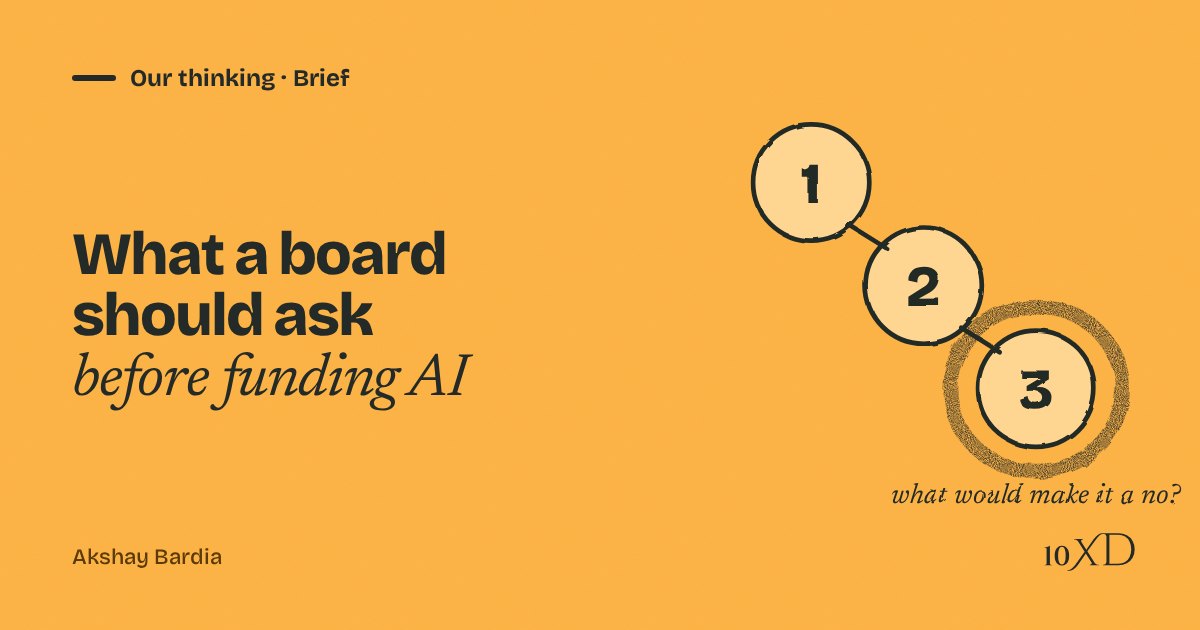
The three questions I'd start with
- Is the foundation there? That means the data, the integrations and the guardrails. Without them, what the board is really funding is a demo. That board's enthusiasm came from seeing real data move through a real system.
- What's the baseline, what's the expected value, and how will we know it worked? That board was clear that the measure was value, not adoption or usage. For their compliance business, value meant the number of anomalies the system found that needed further investigation, and the more it found, the better. Usage tells you a tool is being picked up, but it isn't the return.
- What would it have taken for this to tell us not to go ahead? It was one of the first things they asked. If the honest answer is nothing, then the recommendation hasn't really tested anything.
Three more worth asking
- Where will this fail in production? With real users and real exceptions, not in the demo.
- Who owns the outcome, by name? One owner for the whole system, and one for every step that matters.
- How much change will this put on one role this season, and what comes off their list to make room?
The number has to move the business
Before that board meeting, one of the C-suite kept sending us back to sharpen how we showed the value, again and again, until he was satisfied. His view was simple: if the number isn't driving the business forward, the board won't care.
He was right.
Written by Akshay Bardia, with AI help for research, drafting and editing. The views and experience are his.